
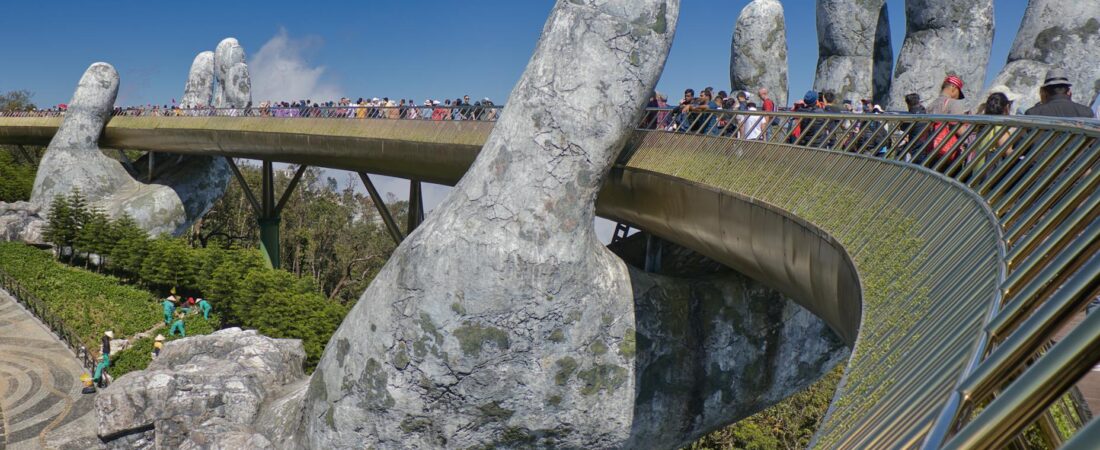
The Golden Bridge in Vietnam is not actually gold, and that detail matters. Built on a hilltop in Da Nang, this structure exists purely to support your phone camera and your sense of wonder. Two giant stone hands emerge from misty clouds, holding up a walkway painted in shades of rust and amber. It looks like something from a fantasy film, which is exactly why every travel magazine on Earth has featured it. For Indian travellers planning Southeast Asia, understanding what you’re actually getting into here shapes everything about your visit.
What Is the Golden Bridge in Vietnam?
The structure sits about 1,400 metres above sea level on Ba Na Hills. It opened to the public just a few years ago, and the response was immediate and overwhelming. The bridge itself stretches only 150 metres long, but those hands carved from the mountainside create an optical illusion that bends perspective. Walking across it, you feel cradled rather than supported. The name “Golden Bridge” comes from the sandy-gold colour of the stone and pathway, not from actual precious metal.
The area around the bridge is part of a larger hill station resort and amusement park. There are cable cars, restaurants, a French village replica, and gardens scattered across the property. Most people spend just 20 to 30 minutes actually on the bridge itself. The broader Ba Na Hills experience extends across the day, which is worth planning for rather than treating as an afterthought.
Tickets and Entry Costs for the Golden Bridge
Getting onto Ba Na Hills requires a ticket, and you cannot avoid this expense. The cable car and park access cost about 750,000 to 850,000 Vietnamese Dong per adult, which converts to roughly 2,500 to 2,800 Indian Rupees. If you’re visiting with family, that adds up quickly. Children aged 3 to 11 pay slightly less, while those under 3 enter free.
These prices cover your round-trip cable car journey to the hilltop and access to the entire Ba Na Hills property. You’re not paying separately to walk on the golden bridge itself. The ticket includes other attractions like the French Village, the gardens, and various viewpoints. Some days have additional charges for specific events or activities, so check online before arriving at the gates.
Purchasing tickets in advance through the official website sometimes offers discounts. You can also book through travel agencies in Da Nang or your hotel. Buying on-site works fine too, but queues can stretch long during peak hours. The peak season runs from October to April when weather is coolest. Plan to buy tickets early in the morning if you show up without a reservation.
How to Reach the Golden Bridge from Da Nang
Da Nang is the nearest city, sitting about 30 kilometres away. Getting there from India requires flying to Ho Chi Minh City or Hanoi first, then catching a domestic flight to Da Nang. These flights take roughly two to three hours. Once you land in Da Nang, you have several options to reach Ba Na Hills.
A private taxi or grab car from Da Nang airport costs about 400,000 to 600,000 Dong, depending on traffic and time of day. The drive takes 45 minutes to an hour. This is the simplest option if you’re travelling with luggage or a group. You pull up to the gate, park, and walk straight to the cable car station. Negotiating with taxi drivers beforehand helps lock in the price, which is standard practice in Vietnam.
- Grab app bookings offer fixed prices and avoid negotiation stress
- Taxis flagged on the street may cost less but haggling is required
- Hotel pickups are pricier but handle luggage and timing smoothly
Your hotel or resort in Da Nang can arrange transportation. This costs more than booking independently, often 800,000 to 1,000,000 Dong, but there’s no guessing involved. The driver arrives on time, knows the route, and drops you at the right entrance. Tour operators in Da Nang also offer packaged trips that include transport, park entry, and sometimes lunch. These run 1,500,000 to 2,000,000 Dong per person depending on what’s included. The trade-off is you’re locked into their timing rather than exploring at your own pace.
Weather and Best Time to Visit
Ba Na Hills sits high enough that weather differs sharply from Da Nang city below. The temperature is 5 to 10 degrees cooler up there, which sounds nice until fog rolls in. Dense clouds blanket the hilltop on many days, completely obscuring the views and the bridge’s visual appeal. This matters because the bridge’s entire purpose is being photographed against dramatic landscapes.
From October through December, the weather is dry and clear. Temperatures hover around 15 to 20 degrees Celsius, making it pleasant without being cold. January through April continues this pattern, though it gets slightly warmer. These months pack the most visitors, and crowds become genuinely frustrating. You’ll find yourself waiting in line just to step onto the bridge.
May to September brings rain and heat. The sky turns grey, moisture saturates everything, and visibility drops. Some days you cannot see more than 20 metres ahead. That doesn’t mean you shouldn’t visit then. Fewer people come during monsoon season, and a moody, cloud-wrapped bridge has a different kind of appeal. Just accept that Instagram photos won’t turn out how you imagined. Know this before booking.
Walking on the Golden Bridge
The actual experience of being on the bridge is surprisingly brief. The walkway is wide enough for two people to pass comfortably. Iron railings run the length, so safety is not a concern. Most visitors spend 10 to 15 minutes here, taking photos from various angles. The real time passes while you wait for your turn to walk it, especially during busy season.
Early morning visits, starting before 8 AM, offer the best photo conditions and smallest crowds. Cable cars run from 7:30 AM onward. You board, ascend through the clouds, then walk straight to the bridge from the cable car station. The walk from the station takes five minutes. Arriving first means you might have the bridge nearly to yourself for a few minutes. That window closes quickly as tour groups arrive.
The bridge has become so famous that some veteran travellers skip it entirely. Others make it their entire Da Nang itinerary. Neither extreme is accurate. The bridge is interesting, worth seeing once, but not worth rearranging your whole trip around. Treat it as one component of a Ba Na Hills visit, not the sole reason to go. That perspective prevents disappointment.
Exploring Beyond the Bridge
Ba Na Hills sprawls across a large area. The French Village sits on the property, featuring replicas of colonial architecture. Walking through colourful streets and yellow buildings does transport you to a different era, though it’s a theme park version of history. Cafes and gift shops line the main street, and prices here are marked up considerably compared to Da Nang.
The gardens and viewpoints scatter throughout the park. Linh Ung Pagoda, a working Buddhist temple on the hilltop, offers different views and a quieter atmosphere. Many Indian travellers appreciate the spiritual aspect here. The cable car ride itself is worth experiencing for the views alone. Going up and down provides different perspectives as clouds shift. The drive down the mountain has switchbacks that offer their own drama.
A full day at Ba Na Hills, without rushing, takes about six to seven hours. This includes cable car time, walking the bridge, exploring villages, eating lunch, and wandering gardens. You can compress it into four hours if you focus only on the bridge and cable car. Most people feel satisfied with a half-day visit, arriving at 8 AM and leaving by early afternoon.
Practical Tips and Warnings
Bring a jacket or sweater regardless of the season. Temperatures drop noticeably at elevation, and wind picks up on exposed areas. Comfortable walking shoes are essential. The pathways are uneven and sometimes steep. Heels look good in photos but become genuinely painful after an hour of walking.
The cafes and restaurants on Ba Na Hills serve decent food at tourist prices. A simple meal costs 150,000 to 300,000 Dong. Bringing snacks from Da Nang costs less and tastes better. Water is available at multiple points, so you don’t need to carry reserves.
Photography is the main activity here. If you’re not interested in photos, the bridge loses much of its appeal. The structural engineering is sound, but the purpose is visual. Consider whether this matches your travel style before investing time and money. Some people find it magical despite the crowds and hype. Others feel it doesn’t deliver on expectations. That’s a personal call.
Crowds are real. During peak season, you’re sharing the bridge with hundreds of people daily. If solitude or peaceful moments matter for your trip, visit during off-season or arrive very early. Late afternoon also sees fewer visitors than midday.
Final Thoughts on Visiting the Golden Bridge
The Golden Bridge in Vietnam delivers something genuine amid all the hype. Two stone hands holding up a walkway creates an image that photographs beautifully. The experience matters more than the destination itself. Standing there, feeling the wind and looking outward, you understand why it became famous so quickly.
For Indian travellers, the bridge fits nicely into a Da Nang or Central Vietnam itinerary. It’s not worth flying to Vietnam solely for this. But if you’re already in the region exploring, spending a morning here makes sense. Budget about 3,000 to 3,500 Indian Rupees per person for tickets, plus transport costs. Allow half a day minimum. Arrive early, take your photos, explore the surrounding park, then head back to Da Nang for dinner. That approach respects both the attraction and your travel schedule.